

Google Ask Maps: What It Is and How It Changes Local Search
Google Ask Maps is transforming how people search for places in 2026. Instead of typing short phrases like “cafes near me,” users can now ask detailed questions and get smart, personalized answers. This new feature is powered by AI and deeply integrated into Google Maps.
With Google Ask Maps, search becomes more natural. Users can ask things like “best quiet cafes with Wi-Fi nearby” or “budget gyms open late.” Google then understands intent and shows relevant results instantly. Therefore, this feature is not just an update. It is a shift in how local search works.
For businesses, this means traditional keyword-based visibility is no longer enough. Context, reviews, and relevance now play a bigger role.
What Is Google Ask Maps? Simple Explanation for Users
Google Ask Maps is an AI-powered feature inside Google Maps that allows users to search using conversational queries. It is powered by advanced AI systems like Gemini, which understand context, preferences, and intent.
Instead of showing a list of results based only on keywords, Google Ask Maps delivers recommendations that match what the user actually wants.
For example, if someone searches “family-friendly restaurants with parking,” Google Ask Maps analyzes multiple factors such as reviews, location, amenities, and popularity. It then provides curated suggestions.
This makes local search faster, smarter, and more personalized.
How Google Ask Maps Works Inside Google Maps
Ask Maps works by combining artificial intelligence with real-time data from Google’s ecosystem. It uses information from Google Business Profiles, user reviews, photos, maps data, and user behavior.
When a user enters a question, the AI processes:
- The intent behind the query
- Location and proximity
- User preferences
- Ratings and reviews
- Business details
Then it generates results that feel more like recommendations rather than search listings.
For instance, if someone asks, “best late-night food options nearby,” Google Ask prioritizes restaurants that are open late, highly rated, and relevant to that query.
Also Read: How to Increase Google Reviews
Where Does Ask Maps Pull Its Information From?
Google has stated that all these features are made possible thanks to Gemini’s creation, reasoning, and summarisation capabilities – grounded in trusted data about places around the world and insights from the Maps community.
In answering Ask Maps questions, Google appears to rely first on content in the business profile, Google Business Profile reviews, and the business website before accessing third-party content.
If that information is not enough, the AI goes further. Ask Maps will go out to third-party web sources if needed to answer a question, provided the site is trusted. This means platforms like Facebook, Carfax, and reputable review sites can also appear in responses.
Also, Ask Maps personalises results based on your Maps history – factoring in places you have searched before, saved places, food preferences, and reviews. Every result, therefore, feels tailored to you.
How to Use Ask Maps on Google Maps (Step by Step)
Getting started with Google Ask Maps is straightforward. Here is how to access and use it:
Step 1: Open the Google Maps app on your Android phone or iPhone.
Step 2: Look for the “Ask Maps” option in the top-left corner of the screen. If the option is not visible, update Maps to the latest version from the Play Store or App Store – it should be on version 26.12.05.884026066 or above.
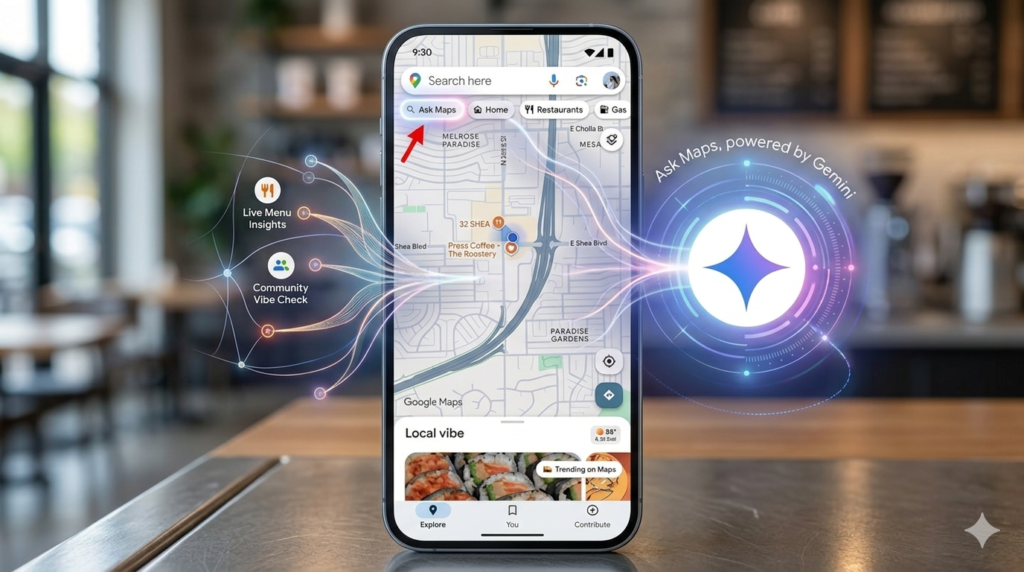
Step 3: Tap on Ask Maps to open the conversational interface.
Step 4: Type your question in natural language. For example: “Best dosa within a 15-minute drive with outdoor seating.” You can also use the microphone for voice queries.
Step 5: Ask Maps will generate a conversational, location-aware response. Scroll down to see the results and refine further with follow-up questions.
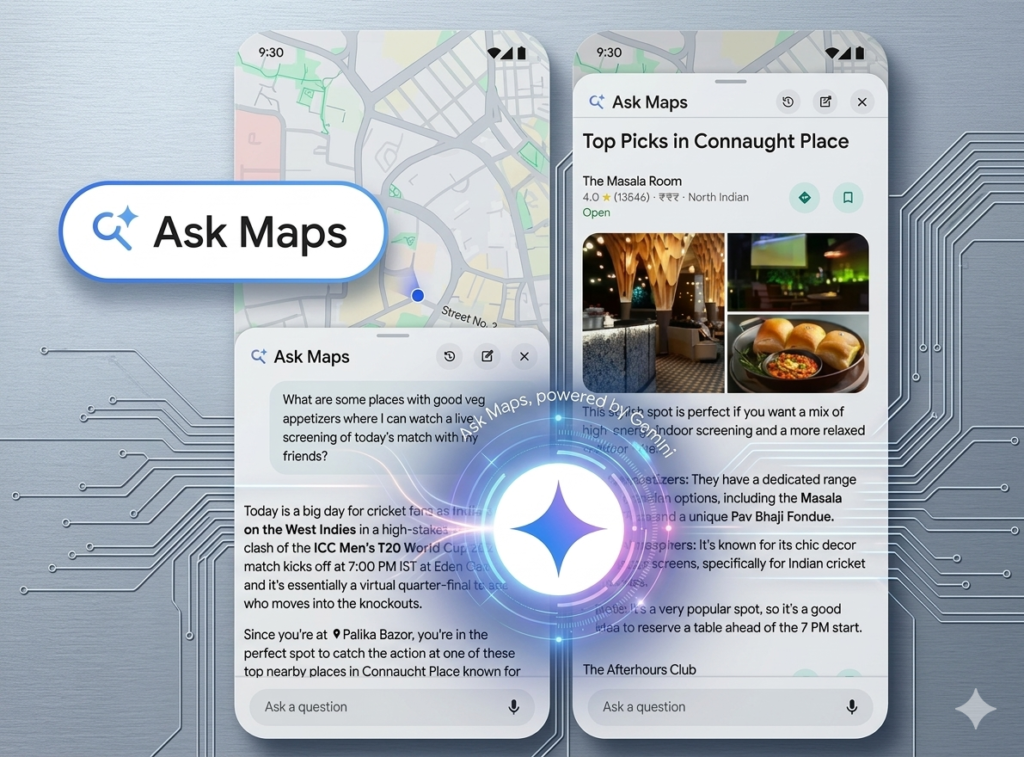
Step 6: For trip planning, you can ask something like: “I am driving from Bangalore to Goa. What are the best food stops along the way?” Ask Maps will map your route and surface relevant stops with ETAs and tips.
This conversational flow makes local discovery far more intuitive than any previous version of Google Maps.
Key Features of Google Ask Maps That Change Search
One of Ask Maps’ biggest strengths is its ability to understand natural language. Users no longer need to think like a search engine. They can simply ask questions in the way they speak.
Another important feature is contextual results. Google does not just show nearby places. It shows places that match the situation.
Personalization is also a key factor. Over time, Ask Maps learns user behavior and improves recommendations.
Finally, it reduces search time. Instead of browsing multiple listings, users get direct answers quickly.
How Google Ask Maps Is Changing Local Search Behavior
Local search behavior is shifting from keywords to conversations. Earlier, users searched using short phrases. Now, they ask detailed and specific questions.
This means users expect more accurate and helpful results. They want suggestions, not just options.
As a result, decision-making becomes faster. Users trust AI recommendations backed by reviews and data.
For example, instead of searching “salon near me,” users may ask “best affordable salon for hair spa near me.” This creates a more refined search experience.
Google Ask Maps vs Traditional Google Maps Search
Traditional Google Maps search focused on keywords, distance, and basic filters. It required users to explore options manually.
Google Ask Maps changes this approach. It delivers results based on intent, context, and user expectations.
Traditional search shows a list.
Google Ask Maps provides recommendations.
Traditional search depends on exact keywords.
Google Ask Maps understands meaning.
This makes the new system more efficient and user-friendly.
What Ask Maps Means for Local Businesses and SEO
Google Ask Maps is not just a user feature. It has serious implications for local SEO and digital marketing strategy. If your business appears in Maps, your visibility now depends on how well Google can answer questions about you.
Optimise Your Google Business Profile Now
Google continues to move down the path of more dynamic AI-generated content on your Google Business Profile. There is every reason to treat your profile as your new homepage and to raise your game in that regard.
This means your profile must be complete, accurate, and rich in detail. Your business hours, categories, photos, services, and description all feed directly into Ask Maps responses. If your profile is thin, Google will either give incomplete answers or skip your business altogether.
Reviews, Photos, and Your Website Matter More Than Ever
Given the ability of tools like Ask Maps to summarise reviews from both Google and around the web, it is more important than ever to diversify your review content and highlight reviews on your website – one of Ask Maps’ most trusted sources.
Original, high-quality photography and video on both your website and Google Business Profile lead to increased engagement and increased conversions. Photos need to be regularly updated at both places for maximum benefit.
Also, your website content is perhaps best viewed as a feed for search and AI engines. It must answer all important customer questions – not just what you do, but how, where, and how well you do it.
For Indian businesses especially, this is a timely reminder. Local SEO is no longer about ranking in a list. It is about being the answer.
Also Read: Digital Marketing for Small Businesses – Proven Strategies to Grow in 2026
Impact of Google Ask Maps on Local SEO and Businesses
Google Ask Maps is redefining local SEO. Businesses can no longer rely only on keywords and basic optimization.
Now, Google evaluates:
- Quality of reviews
- Relevance of services
- Accuracy of business information
- User engagement
- Consistency of content
Businesses with strong profiles, updated information, and positive reviews will perform better.
Local SEO is shifting toward trust and experience. Businesses must focus on providing real value to customers.
How Businesses Can Optimize for Google Ask Maps in 2026
To stay visible in Google Ask Maps, businesses must adapt their strategy.
Start by optimizing your Google Business Profile. Ensure all details are accurate, including services, timings, categories, and photos.
Encourage customers to leave detailed reviews. Reviews now play a major role in how AI understands your business.
Use natural language in descriptions. Think about how users ask questions and align your content accordingly.
Add relevant images and keep your profile active with updates and posts.
Consistency across platforms also helps. Google trusts businesses with strong online presence.
Real-Life Examples of Google Ask Maps in Action
Let’s look at how users interact with Google Ask Maps.
A user searching for “best cafes for work near me” will see cafes with Wi-Fi, good seating, and positive reviews for productivity.
Someone asking “budget gyms open early morning” will get gyms that match pricing and timing preferences.
A family searching “restaurants with kids play area nearby” will receive highly relevant suggestions instantly.
These examples show how Google Ask Maps focuses on user intent rather than just keywords.
Benefits of Google Ask Maps for Users and Businesses
For users, Google Ask Maps saves time and improves decision-making. It provides accurate, personalized, and quick results.
For businesses, it creates new opportunities to reach customers. Businesses that align with user intent can gain higher visibility.
It also improves customer experience. Users find what they need faster, and businesses attract more relevant customers.
Challenges and Limitations of Google Ask Maps
While Google Ask Maps is powerful, it has some challenges.
AI may sometimes misinterpret queries.
New businesses with fewer reviews may struggle to appear.
Highly competitive areas may require stronger optimization.
However, as the system improves, these limitations will reduce over time.
The Future of Local Search with Google Ask Maps and AI
Google Ask Maps represents the future of search. AI will continue to make search more conversational and personalized.
Voice search will grow alongside this trend. Users will interact with maps using voice commands.
Local search will become more predictive. Google will suggest places even before users search.
Businesses that adapt early will benefit the most.
Is Ask Maps Available in India? Availability and Rollout
Yes, and this is great news for Indian users. Ask Maps is currently rolling out in India on Android and iOS for free. Google has also confirmed it is coming to desktop soon.
While Ask Maps is already rolling out on Android and iOS, it is a server-side rollout, so it may take a few days to reach your device. If you do not see it yet, update your Google Maps app and force-stop it to check again.
It is worth noting that the feature is not available in all categories. The feature is excluded from most healthcare providers, counselling, social services, pregnancy care, and drug rehab centres, as well as highly distressed and spammy categories like moving companies and locksmiths. The primary category of your Google Business Profile determines whether Ask Maps appears on your listing.
For Indian marketers and business owners, the message is clear. Get your digital presence in order now – because Ask Maps is coming, and it will decide what information users see about your business.
Conclusion
Google Ask Maps is not just a feature. It is a major shift in how people search and discover businesses. It moves local search from keywords to conversations. It prioritizes relevance, trust, and user experience.
For businesses, this means focusing on real value, strong profiles, and customer satisfaction. Those who adapt to this change will gain a strong advantage in 2026 and beyond.
Want to Optimize Your Business for Google Ask Maps?
As local search evolves, businesses need to adapt quickly. Google Ask Maps rewards those who understand customer intent and provide real value.
If you want to improve your local visibility, optimize your Google presence, and stay ahead of competitors, Blow Horn Media can help you build a strategy that works for the future of search.
Let’s grow your visibility where your customers are searching today.
Frequently Asked Questions About Google Ask Maps
What is Google Ask Maps?
Ask Maps is an AI-powered feature in Google Maps that lets users ask complex, natural-language questions about places and get context-aware, personalised answers.
Is Ask Maps different from regular Google Maps search?
Yes. Traditional search matches keywords to listings. Ask Maps understands intent, context, and multi-part questions – then gives a conversational, curated answer.
Is Ask Maps available in India?
Yes. Ask Maps is rolling out in India on Android and iOS as of March 2026. Availability depends on your app version and server-side rollout timing.
Does Ask Maps replace Google Q&A on Business Profiles?
A contributor in the Google support forums was recently told that the current Q&A feature is being deprecated. Ask Maps does a significantly better job of answering questions by using a limited number of reliable sources.
How can businesses optimise for Ask Maps?
Keep your Google Business Profile complete and updated. Collect diverse reviews. Publish detailed, question-answering content on your website. Post high-quality photos regularly.